Complete Guide to PVC Window Production Machinery: List & Costs 2026
Discover the complete list of essential PVC window production machinery. Get detailed insights on machine functions, workflow stages, and estimated investment costs for your factory.
Complete Guide to PVC Window Production Machinery: Full List & Costs 2026
PVC window production, with the right machinery investment and a planned production line, offers both high quality and sustainable profitability. As of 2026, increasing energy efficiency standards and demand in the construction sector have further increased interest in PVC window production machinery. In this comprehensive guide, we detail all the necessary machinery, production stages, and current investment costs for establishing a PVC window factory.
Building a Successful uPVC Manufacturing Plant
Establishing a competitive uPVC manufacturing facility requires deep knowledge of the essential PVC window production machinery and its role in the workflow. The global demand for energy-efficient windows is growing, offering significant opportunities for new investors and existing manufacturers aiming to upgrade. However, success depends not just on acquiring equipment, but on creating an integrated production line where every stage delivers precision.
The quality of the final window is directly tied to the reliability and accuracy of the equipment used, from the initial profile cutting to final assembly. This guide provides a comprehensive breakdown of the necessary capital equipment. We will examine the entire fabrication line step-by-step, explaining the function of each unit, and provide realistic estimates of the investment costs involved for 2025.
The Full List: Essential uPVC Fabrication Equipment
A standard uPVC window production line is divided into distinct operational phases: Cutting, Machining, Welding, Corner Cleaning, and Assembly. Below is the complete list of machinery required for a fully functional workflow.
Cutting and Preparation Stations
The accuracy of the initial cut is paramount, as it determines the weld quality and the final dimensional precision of the window frame.
1. PVC Profile Cutting Machine
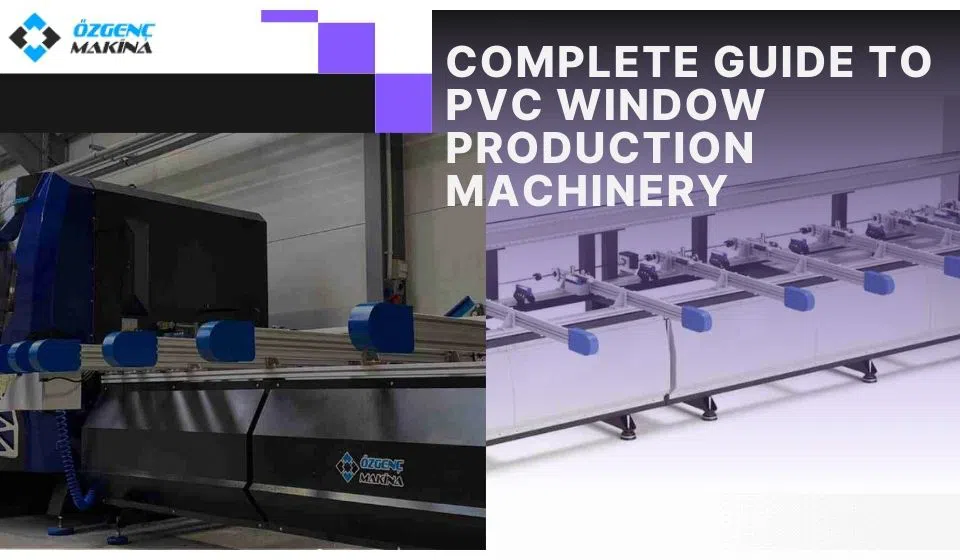
This is the starting point of production. These units cut 6-meter PVC profile bars into required lengths and angles (typically 45° for frames/sashes, 90° for mullions).
- Single Head Cutting Saw: Suitable for start-ups or lower volume needs. The operator manually feeds the profile and adjusts angles.
- Double Head Cutting Saw: The industry standard for medium to high production efficiency. It cuts both ends of a profile simultaneously, significantly increasing speed and ensuring precise length accuracy. Advanced models are fully CNC controlled, reading data directly from optimization software.
- Key Feature: Look for saws with hydropneumatic feeding systems for smooth operation and high-quality carbide blades to minimize burrs.
2. Reinforcement Steel Cutting Machine
uPVC profiles require internal structural support for larger window sizes. Galvanized steel reinforcement bars are inserted inside the central chamber. This specific metal cut-off saw is designed to slice through these steel bars quickly and cleanly.
3. Glazing Bead Cutting Saw (V-Cut)
Glazing beads secure the glass unit inside the sash. This specialized equipment cuts two 45° angles simultaneously on the bead profile. Precision here is vital to create a perfect 90° joint, avoiding unsightly gaps where beads meet at the corners.
Machining and Processing Centers
Before welding, the cut profiles require various slots and holes for hardware integration and water drainage.
4. Copy Router Machine (Pantograph)
This versatile unit uses a template to trace and cut standard shapes onto the PVC surface. It is primarily used for opening slots for handles (espagnolette holes), lock cylinders, and hinges. Variants range from manual operation to multi-spindle versions that drill handle and screw holes in a single cycle.
5. Water Slot Milling Machine (Drainage)
PVC frames must have internal channels to evacuate rainwater. This machine mills small slots on the inside and outside faces of the profile to allow water escape. It typically employs multiple motors to handle different angles and positions efficiently.
6. End Milling Machine (Mullion Cutting)
Creating a "T" joint (connecting a mullion bar to an outer frame) requires shaping the end of the mullion profile to fit the frame's contour exactly. The end milling machine uses custom cutter stacks to carve this precise shape.
Welding Machinery
In this phase, separate PVC pieces are fused into a window frame. The profiles are joined by melting their ends using heater plates (approx. 240°C - 260°C) and pressing them together.
7. PVC Welding Machine
The quality of the weld defines the corner strength and durability of the window.
- Single Head Welder: Welds one corner at a time. Slow but flexible for non-standard angles.
- Double Head Welder: Joins two corners of a frame simultaneously, offering a balance of speed and investment.
- Four Head Welder: The ultimate high-production solution. It welds all four corners of a frame or sash in a single, synchronized cycle. This ensures perfect squareness and maximizes throughput, making it essential for large-scale operations.
Finishing and Quality Control
The welding process pushes molten PVC outwards, creating a hard ridge known as a welding bead or "sprue." This must be removed for both aesthetic and functional reasons.
8. Corner Cleaning Machine
This equipment removes the welding bead from the frame's top surface, bottom surface, and outer corner edge.
- Manual/Semi-Auto Cleaners: Utilize separate stations or tools for surface and edge cleaning. These are labor-intensive.
- CNC Corner Cleaning Machine: A fully automated unit that recognizes profile types and uses various tools (saw blades, milling cutters, surface knives) to clean the entire corner perfectly in one operation. It provides a seamless, high-quality finish, often linked directly to a four-head welder.
Assembly and Logistics (Recommended Add-ons)
For enhanced efficiency and reduced manual handling, supplementary equipment is highly recommended.
- Automatic Screwdriver Machine: Automates fastening reinforcement steel inside the PVC profile.
- Hardware Mounting Station: Dedicated tables with pneumatic tools for rapid attachment of hinges and locking mechanisms.
- Profile and Sash Trolleys: Essential for organizing workflow and safely transporting materials between stations.
Understanding Investment Costs 2026
The capital required for a PVC window factory varies significantly based on desired production capacity, automation levels, and machinery origin (e.g., European vs. Asian manufacturers). Turkish machinery often provides an excellent balance of high quality and competitive pricing globally.
Disclaimer: These figures are rough estimates for machinery only; they exclude land, building, raw materials, and labor costs.
Tier 1: Entry-Level Workshop (Capacity: 15-30 windows/shift)
Ideal for small local businesses, relying heavily on manual labor.
- Equipment: Single head saw, single head welder, manual corner cleaning tools, manual copy router, end miller.
Tier 2: Standard Factory (Capacity: 40-80 windows/shift)
The common setup for growing businesses, balancing speed and cost.
- Equipment: Double head cutting saw, double head welder, semi-automatic or basic CNC corner cleaner, dedicated water slot machine, automated copy router.
Tier 3: High-Volume Automated Plant (Capacity: 150+ windows/shift)
For large-scale manufacturing with minimal manual intervention, focusing on maximum efficiency.
- Equipment: Fully automated CNC cutting and processing center, four-head welding line integrated automatically with a CNC corner cleaning machine, automated logistics systems.
Estimated investment for customized and competitive pricing for your company, please contact us.
Selecting the appropriate PVC window production machinery is a strategic balance between current budget constraints and future growth projections. While starting with basic equipment is feasible, investing in higher precision machinery, such as double-head saws and CNC cleaners, can significantly reduce material waste and improve product quality from day one, leading to a faster ROI. Before finalizing any purchase, always consult with established machinery manufacturers to design a workflow tailored to your specific needs.